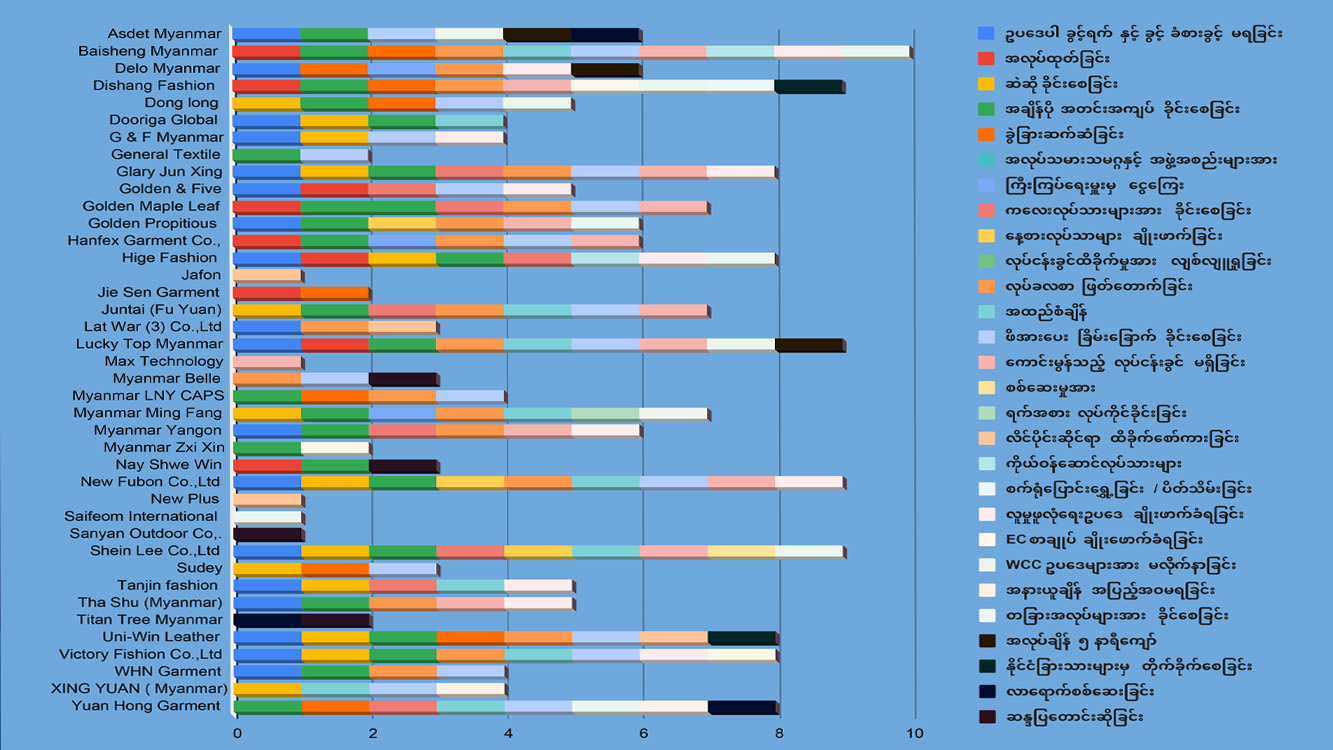

A total of 43 news reports on violations of labour laws and workers’ rights were published by Myanmar Labour News in February 2026.
The Myanmar Labour Society studied these violations and found that they involved 40 factories.
The types of businesses among these factories include manufacturing of wallets, shoes, handbags, garments, and hats, as well as electronics industries.
Among these enterprises, there was 1 wallet manufacturing factory, 1 shoe manufacturing factory, 1 handbag manufacturing factory, 34 garment factories, 2 hat manufacturing factories, and 1 electronics factory.
The number of workers ranged from around 150 in the smallest factory to approximately 1,700 workers in the largest factory in the list.
The Myanmar Labour Society has been studying violations of labour laws and workers’ rights through the Myanmar Labour News website.
The violations reported in the news are being analyzed across 28 categories.
The analytical categories are based on existing Myanmar labour laws, the provisions of the International Labour Organization (ILO) that Myanmar has signed and pledged to follow, as well as human rights principles and social standards.
The information obtained from these studies is being released in monthly and annual reports.
Factories and Products Reported in News During February 2026
|
No |
Factory |
Industry Type |
Brand |
Factory Location |
News Report |
|
1 |
Baisheng Myanmar Industry Co., Ltd |
Shoe Manufacturing |
HI-TEC |
Yangon–Pathein Highway, Htantabin Township, Yangon Region, Myanmar |
|
|
2 |
Dishang Fashion (Myanmar) |
Garment |
ONLY, Pimkie, First Down, Java, a.v.v, niko and…, Field Gear Club |
Phanchat Wun U Myu Road, East Dagon Industrial Zone, East Dagon Township, Yangon City, Yangon Region, Myanmar |
|
|
3 |
Lucky Top Myanmar |
Garment |
Min Gyi Maha Min Khaung Road, Shwe Than Lwin Industrial Zone, Hlaingtharyar Township, Yangon City, Yangon Region, Myanmar |
||
|
4 |
New Fubon Co., Ltd |
Garment |
Plus |
Pyin Si Min Thar Gyi Road, Shwe Lin Ban Industrial Zone, Hlaingtharyar Township, Yangon City, Yangon Region, Myanmar |
|
|
5 |
Shein Lee Co., Ltd |
Garment |
WearGuard, Vestis, Craft, Tuff Athletics |
Kanaung Min Thar Gyi Road, Shwe Lin Ban Industrial Zone, Hlaingtharyar Township, Yangon City, Yangon Region, Myanmar |
|
|
6 |
Glary Jun Xing Garment |
Garment |
Sinsay |
Building No.270, Pan Be Khaung Maung Khat Road, Shwe Lin Ban Industrial Zone, Yangon City, Yangon Region, Myanmar |
|
|
7 |
Hige Fashion Accessories Myanmar Co., Ltd |
Hat Manufacturing |
Xshelte |
Twinthinthike Wun U Tun Nyo Road, Shwe Lin Ban Industrial Zone, Hlaingtharyar Township, Yangon City, Yangon Region, Myanmar |
|
|
8 |
Uni-Win Leather |
Wallet Manufacturing |
Paik Kyi Wae Village, Hlegu Township, Yangon Region, Myanmar |
||
|
9 |
Victory Fishion Co., Ltd (Myanmar Huasheng Kefu Fashion Co., Ltd) |
Garment |
Myakhattar Road, Mya Sein Yaung Industrial Zone, Hlaingtharyar Township, Yangon City, Yangon Region, Myanmar |
||
|
10 |
Yuan Hong Garment Co., Ltd |
Garment |
American Holic, Defacto, Hush Puppies, Begum, Gemo |
Twinthinthike Wun U Tun Nyo Road, Shwe Lin Ban Industrial Zone, Hlaingtharyar Township, Yangon City, Yangon Region, Myanmar |
|
|
11 |
Juntai (Fu Yuan) Garment Co., Ltd |
Garment |
AMISU |
Mya Sein Yaung Industrial Zone, Hlaingtharyar Township, Yangon City, Yangon Region, Myanmar |
|
|
12 |
Myanmar Ming Fang |
Garment |
Near Kanthaya Bus Stop, Shwe Pyi Thar Industrial Zone (1), Shwe Pyi Thar Township, Yangon City, Yangon Region, Myanmar |
||
|
13 |
Asdet Myanmar Garment |
Garment |
Near Fire Station, Mee That Kan Road, Shwe Lin Ban Industrial Zone, Hlaingtharyar Township, Yangon City, Yangon Region, Myanmar |
||
|
14 |
Delo Myanmar Garment |
Garment |
Min Ayeyar Road, Shwe Than Lwin Industrial Zone, Hlaingtharyar Township, Yangon City, Yangon Region, Myanmar |
||
|
15 |
Golden Maple Leaf Myanmar |
Garment |
Rolywrk, Lvcunv |
Saya San Road, Shwe Lin Ban Industrial Zone, Hlaingtharyar Township, Yangon City, Yangon Region, Myanmar |
|
|
16 |
Golden Propitious (Myanmar) Co., Ltd |
Garment |
SMOG |
Thadukan Industrial Zone, Shwe Pyi Thar Township, Yangon City, Yangon Region, Myanmar |
|
|
17 |
Hanfex Garment Co., Ltd |
Garment |
Celio |
Road 2, Ngwe Pin Lel Industrial Zone, Hlaingtharyar Township, Yangon City, Yangon Region, Myanmar |
|
|
18 |
Myanmar Yangon Richang Apparel (Nisho) |
Garment |
American Holic, Calelf Class |
U Yay Paw Road, Shwe Lin Ban Industrial Zone, Hlaingtharyar Township, Yangon City, Yangon Region, Myanmar |
|
|
19 |
Dong Long |
Garment |
Ward 13, Kin Ma Lin Island, Pathein Industrial Zone, Pathein City, Ayeyarwady Region, Myanmar |
||
|
20 |
Golden & Five Myanmar Co., Ltd |
Garment |
Mya Sein Yaung Industrial Zone, Hlaingtharyar Township, Yangon City, Yangon Region, Myanmar |
||
|
21 |
Tanjin Fashion Milestone Co., Ltd |
Garment |
Sinsay |
Seikkanthar Road, Shwe Lin Ban Industrial Zone, Hlaingtharyar Township, Yangon City, Yangon Region, Myanmar |
|
|
22 |
Tha Shu (Myanmar) Glory Fashion |
Garment |
Large |
Than Lwin Road, Shwe Than Lwin Industrial Zone, Hlaingtharyar Township, Yangon City, Yangon Region, Myanmar |
|
|
23 |
Dooriga Global Garment |
Garment |
Glacier, SPAO, Giordano |
Lwan Swat Village, Thilawa Industrial Zone, Thanlyin Township, Yangon Region, Myanmar |
|
|
24 |
G & F Myanmar |
Garment |
YAMAMAY, GEMO, UNDIZ |
Kalihtaw Village, Hlegu Township, Yangon Region, Myanmar |
|
|
25 |
Myanmar LNY CAPS Co., Ltd (1) |
Hat Manufacturing |
47 CLEAN UP, FITCAP, OTTO, CAPAMERICA |
Malika Road, Shwe Than Lwin Industrial Zone, Near BOC Bus Stop, Yangon City, Yangon Region, Myanmar |
|
|
26 |
WHN Garment |
Garment |
ET VOUS, PROMOD, CALLOPE, PUNT |
Saya San Road, Shwe Lin Ban Industrial Zone (2), Hlaingtharyar Township, Yangon City, Yangon Region, Myanmar |
|
|
27 |
XING YUAN (Myanmar) Co., Ltd |
Garment |
Thein Chaung Road, Wataya Industrial Zone, Shwe Pyi Thar Township, Yangon Region, Myanmar |
||
|
28 |
Lat War (3) Co., Ltd |
Garment |
KAPALUA, REGATA, MAVI CONIN’s |
Seikkan Thar Road, Industrial Zone (2), Hlaingtharyar Township, Yangon City, Yangon Region, Myanmar |
|
|
29 |
Myanmar Belle International Co., Ltd |
Garment |
Sinsay |
Myatharaphy Road, Mya Sein Yaung Industrial Zone, Yangon City, Yangon Region, Myanmar |
|
|
30 |
Nay Shwe Win Garment |
Garment |
Wataya Industrial Zone, Yangon Region, Myanmar |
||
|
31 |
Sudey |
Garment |
Shanywargyi Village, Kli Village Tract, Bago Township, Bago Region, Myanmar |
||
|
32 |
General Textile (Myanmar) Apparel |
Garment |
Hmawbi Township, Yangon Region, Myanmar |
||
|
33 |
Jie Sen Garment (Myanmar) Co., Ltd |
Garment |
MACKAGE |
Min Gyi Maha Min Khaung Road, Shwe Pyi Thar Industrial Zone (3), Insein Township, Yangon City, Yangon Region, Myanmar |
|
|
34 |
Myanmar Zxi Xin |
Garment |
HOP-SCOT |
Pan Be Khaung Maung Khat Road, Shwe Lin Ban Industrial Zone, Hlaingtharyar Township, Yangon City, Yangon Region, Myanmar |
|
|
35 |
Titan Tree Myanmar Co., Ltd (Tha Shu) |
Garment |
CHEEKY, CDRL, COCCODRILLO |
Saya San Road, Hlaingtharyar Industrial Zone (2), Hlaingtharyar Township, Yangon City, Yangon Region, Myanmar |
|
|
36 |
Jafon |
Handbag Manufacturing |
IPSY, GLAM BAG, Gucci |
Naga Wun Road, Bago Industrial Zone, Bago City, Bago Region, Myanmar |
|
|
37 |
Max Technology |
Electronics |
Headphones |
Wataya Industrial Zone, Shwe Pyi Thar Township, Yangon City, Yangon Region, Myanmar |
|
|
38 |
New Plus |
Garment |
Kyauk Sein Road, Thadukan Industrial Zone, Shwe Pyi Thar Township, Yangon City, Yangon Region, Myanmar |
||
|
39 |
Saifeom International Garment |
Garment |
Min Gyi Maha Min Khaung Road, Shwe Than Lwin Industrial Zone, Yangon City, Yangon Region, Myanmar |
||
|
40 |
Sanyan Outdoor Co., Ltd |
Garment |
Sinsay, SNSY OUT WERE, Sinsay Mens |
Thein Kyaung Road, Wataya Industrial Zone, Shwe Pyi Thar Township, Yangon Region, Myanmar |
Violations are listed from highest to lowest frequency.
February 2026 Violations
|
Violation Type |
Number of Times Reported in News |
Number of News Reports |
|
Forced Overtime |
26 |
25 |
|
Intimidation and Coercion |
20 |
20 |
|
Wage Deductions |
19 |
19 |
|
Denial of Legal Leave and Leave Entitlements |
18 |
18 |
|
Verbal Abuse |
14 |
14 |
|
Lack of Decent Working Conditions |
13 |
13 |
|
Forced Production Targets |
11 |
11 |
|
Violations of Social Security Law |
11 |
11 |
|
Non-Compliance and Violations of WCC Regulations |
11 |
11 |
|
Dismissals |
9 |
9 |
|
Discrimination |
9 |
9 |
|
Use of Child Labour |
9 |
9 |
|
Sexual Harassment |
4 |
4 |
|
Worker Protests and Demands |
4 |
4 |
|
Wage Deductions by Supervisors |
3 |
3 |
|
Violations against Daily Wage Workers |
3 |
3 |
|
Violations of Employment Contract (EC) |
3 |
3 |
|
Forcing Workers to Work More Than 5 Continuous Hours |
3 |
3 |
|
Inspections Conducted |
3 |
3 |
|
Violations against Pregnant Workers |
2 |
2 |
|
Insufficient Rest Breaks |
2 |
2 |
|
Direct Orders by Foreign Supervisors |
2 |
2 |
|
Instructing Workers to Provide False Statements or Avoid Inspections |
1 |
1 |
|
Forcing Work on Substitute Rest Days |
1 |
1 |
|
Forcing Workers to Perform Other Tasks |
1 |
1 |
|
Suppression or Dissolution of Labour Unions and Organisations |
0 |
0 |
|
Ignoring Workplace Injuries |
0 |
0 |
|
Factory Relocation / Closure |
0 |
0 |
The findings are intended to support the emergence of laws aligned with international standards, the protection and realization of workers’ rights, the provision of wages appropriate to the times, and the creation of workplaces that comply with social standards.
In addition, the information is intended to be used by those studying the labour sector, workers, trade unions, labour federations, labour rights activists, and individuals seeking to bring about change within the sector.
Among the findings identified in February were violations of Myanmar labour laws, including forced overtime, denial of rest days, denial of leave entitlements, the use of child labour, and violations of maternity rights. Violations of the provisions of the International Labour Organization (ILO) and internationally recognized standards were also identified, including forced labour, restrictions on freedom of association, and workplace harassment and abuse.
From the perspective of social standards and human rights, violations were also found in areas related to human dignity, health, and safety. In addition, the role of the Workplace Coordination Committee (WCC), which is the most fundamental workplace negotiation mechanism between employers and workers, was found to be dysfunctional. Weak enforcement actions by the authorities (labour offices) were also observed.
A notable development during this month was the discovery that Code of Conduct (CoC) staff members at the garment factories Dishang Fashion (Myanmar) and Hige Fashion Accessories Myanmar Co., Ltd committed ethical violations and acts of harassment.
According to the Code of Conduct (CoC), monitoring workers should not be carried out to find faults but rather to ensure that workers are safe and that their rights are being respected.
CoC staff are expected to act as neutral parties who safeguard fairness between workers and employers. However, the incidents that occurred in February not only damaged the reputation of the factories but also undermined the trust in the brands for which the products are manufactured.
There are three CoC staff members at Dishang Fashion (Myanmar). They monitored workers through CCTV when workers placed complaint letters in the suggestion box, which is commonly used to report workplace violations.
This monitoring was not conducted to provide support. Instead, workers were summoned and pressured to act in favour of the factory’s position. Workers who came to submit letters were targeted and blamed, and line leaders were pressured to speak against those workers.
A CoC staff member was found to have committed harassment against a pregnant worker through discriminatory behaviour based on social standards at Hige Fashion Accessories Myanmar Co., Ltd. The staff member was also involved in the process of dismissing the worker.
These actions were intentional and constitute what is known as “Administrative Harassment.” Instead of dismissing a worker legally with proper compensation, the worker is subjected to various forms of pressure and mistreatment to make them lose morale and resign voluntarily so that compensation does not have to be paid.
The Myanmar Labour Society also found that when factory workers experience violations of their workplace rights, they tend to rely sequentially on line leaders, supervisors, managers, HR staff, and CoC staff for assistance.
Forced Overtime
Forced overtime constitutes a violation under Myanmar labour law and is also considered forced labour under the provisions of the International Labour Organization (ILO). In the news reports published in February, violations included requiring workers to work without rest days, including on Sundays and other official holidays; imposing overtime that could harm workers’ health such as “midnight” and “overnight” shifts; forcing workers to work late at night or until morning without rest breaks and then requiring them to work again the following day without providing a day off; threatening dismissal if workers refused overtime; deducting attendance bonuses, grade allowances, and other incentives when workers refused overtime; verbally abusing workers; failing to arrange transportation for workers; and requiring child labour to work.
According to Myanmar labour law, “overtime (OT) may only be required when there is mutual agreement between the employer and the worker.”
In February, 25 factories were found to have forced workers to perform overtime. These included 2 hat factories, 2 shoe factories, and 21 garment factories. 25 factories were found to have imposed forced overtime among a total of 40 factories involved in violations during February.
The factories involved in forced overtime were: Asdet Myanmar Garment, Baisheng Myanmar Industry Co., Ltd, Dishang Fashion (Myanmar), Dong Long, Dooriga Global Garment, General Textile (Myanmar) Apparel, Glary Jun Xing Garment, Golden Maple Leaf Myanmar, Golden Propitious (Myanmar) Co., Ltd, Hanfex Garment Co., Ltd, Hige Fashion Accessories Myanmar Co., Ltd, Juntai (Fu Yuan) Garment Co., Ltd, Lucky Top Myanmar, Myanmar LNY CAPS Co., Ltd (1), Myanmar Ming Fang, Myanmar Yangon Richang Apparel (Nisho), Myanmar Zxi Xin, Nay Shwe Win Garment, New Fubon Co., Ltd, Shein Lee Co., Ltd, Tha Shu (Myanmar) Glory Fashion, Uni-Win Leather, Victory Fishion Co., Ltd (Myanmar Huasheng Kefu Fashion Co., Ltd), WHN Garment, and Yuan Hong Garment Co., Ltd.
Intimidation and Coercion
Intimidation and coercion represent the use of fear as a tool against workers.
Examples of such practices include threatening workers with dismissal if they refuse overtime; forcing workers to sign warning letters; forcing workers to sign documents for not meeting production targets and threatening dismissal after three warnings; HR staff stating that workers would be dismissed if they did not comply; threatening to deduct attendance bonuses if workers take leave or refuse overtime; pressuring workers by threatening to cut skill allowances if employers are dissatisfied; threatening to reduce wages owed when workers attempt to resign due to intolerable conditions; verbally abusing workers; threatening workers with statements such as “I will stab you with scissors”; committing physical assaults; humiliating workers publicly; refusing to allow workers who are ill to leave work and forcing them to remain in the workplace; threatening workers with dismissal if they take leave; monitoring workers like prisoners; and following workers to the toilet.
These violations were committed separately by 20 factories, including factories producing wallets, hats, shoes, and garments. Among the 40 factories involved in violations during the month, 20 were found to have committed this type of abuse.
These factories include: Asdet Myanmar Garment, Baisheng Myanmar Industry Co., Ltd, Dong Long, G & F Myanmar, General Textile (Myanmar) Apparel, Glary Jun Xing Garment, Golden & Five Myanmar Co., Ltd, Golden Maple Leaf Myanmar, Hanfex Garment Co., Ltd, Juntai (Fu Yuan) Garment Co., Ltd, Lucky Top Myanmar, Myanmar Belle International Co., Ltd, Myanmar LNY CAPS Co., Ltd (1), New Fubon Co., Ltd, Sudey, Uni-Win Leather, Victory Fishion Co., Ltd (Myanmar Huasheng Kefu Fashion Co., Ltd), WHN Garment, XING YUAN (Myanmar) Co., Ltd, and Yuan Hong Garment Co., Ltd.
The forced imposition of production targets is another form of coercion against workers. Such practices constitute psychological and physical pressure on workers and amount to forced labour or coercion, as well as legal and ethical violations. In these situations, workers not only experienced verbal abuse, humiliation, and pressure to sign warning letters, but also suffered financial losses and restrictions on their fundamental rights.
In February, 11 factories were found to have forced production targets on workers. These factories were: Baisheng Myanmar Industry Co., Ltd, Dooriga Global Garment, Juntai (Fu Yuan) Garment Co., Ltd, Lucky Top Myanmar, Myanmar Ming Fang, New Fubon Co., Ltd, Shein Lee Co., Ltd, Tanjin Fashion Milestone Co., Ltd, Victory Fishion Co., Ltd (Myanmar Huasheng Kefu Fashion Co., Ltd), XING YUAN (Myanmar) Co., Ltd, and Yuan Hong Garment Co., Ltd.
Wage Deductions
Various forms of wage deductions were reported during February. These included deducting daily wages and attendance bonuses by marking workers absent without granting medical leave or emergency leave; withholding bonuses for refusing overtime; reducing skill allowances (grade allowances); deducting wages for arriving late, using mobile phones during working hours, or responding to supervisors; deducting wages for purchasing medicine; deducting unexplained amounts from wages; deducting tax without providing supporting documentation; forcibly collecting donation contributions; reducing wages when workers resign; misappropriating bonuses; deducting money for obtaining gate passes; and reducing meal allowances and transportation allowances.
A total of 19 factories committed one or more forms of these wage deduction practices.
Employers may deduct wages only for specific reasons such as absence from work, services agreed upon between employer and worker, salary advances, income tax, social security contributions, and fines according to Myanmar’s Payment of Wages Law (2016). However, the total deductions must not exceed 50 percent of the worker’s wages.
Among the wage deduction cases, it was also found that some deductions were carried out unlawfully by line leaders.
The factories involved in wage deductions include hat, wallet, shoe, and garment factories. These factories were: Baisheng Myanmar Industry Co., Ltd, Delo Myanmar Garment, Dishang Fashion (Myanmar), Glary Jun Xing Garment, Golden Maple Leaf Myanmar, Golden Propitious (Myanmar) Co., Ltd, Hanfex Garment Co., Ltd, Juntai (Fu Yuan) Garment Co., Ltd, Lat War (3) Co., Ltd, Lucky Top Myanmar, Myanmar Belle International Co., Ltd, Myanmar LNY CAPS Co., Ltd (1), Myanmar Ming Fang, Myanmar Yangon Richang Apparel (Nisho), New Fubon Co., Ltd, Tha Shu (Myanmar) Glory Fashion, Uni-Win Leather, Victory Fishion Co., Ltd (Myanmar Huasheng Kefu Fashion Co., Ltd), and WHN Garment.
Factories where line leaders were reported to have deducted workers’ wages include Delo Myanmar Garment, Hanfex Garment Co., Ltd, and Myanmar Ming Fang garment factories.
Denial of Legal Leave and Leave Entitlements
Workers were also found to have been denied legal leave entitlements, including emergency leave and medical leave as provided under labour law.
Violations included refusing to grant leave and marking workers absent, followed by deductions from daily wages, attendance bonuses, and skill allowances (grade allowances); denying pregnant workers access to medical or emergency leave and preventing them from receiving social security benefits; refusing to issue gate passes for medical purposes and imposing financial deductions; forcing workers to perform overtime on weekly rest days and public holidays; threatening workers with grade reduction or dismissal if they take leave; dismissing workers for taking leave; reducing medical leave days and forcing workers to return to work; and pressuring workers to personally submit social security leave applications.
Violations related to leave entitlements, including the denial of medical leave, occurred in a total of 18 factories. These factories were: Asdet Myanmar Garment, Delo Myanmar Garment, Dooriga Global Garment, G & F Myanmar, Glary Jun Xing Garment, Golden & Five Myanmar Co., Ltd, Golden Propitious (Myanmar) Co., Ltd, Hige Fashion Accessories Myanmar Co., Ltd, Lat War (3) Co., Ltd, Lucky Top Myanmar, Myanmar Yangon Richang Apparel (Nisho), New Fubon Co., Ltd, Shein Lee Co., Ltd, Tanjin Fashion Milestone Co., Ltd, Tha Shu (Myanmar) Glory Fashion, Uni-Win Leather, Victory Fishion Co., Ltd (Myanmar Huasheng Kefu Fashion Co., Ltd), and WHN Garment.
These factories include garment factories, wallet manufacturing factories, and hat factories.
Factories that violated provisions related to social security medical leave include: Baisheng Myanmar Industry Co., Ltd, Delo Myanmar Garment, G & F Myanmar, Glary Jun Xing Garment, Golden & Five Myanmar Co., Ltd, Hige Fashion Accessories Myanmar Co., Ltd, Myanmar Yangon Richang Apparel (Nisho), New Fubon Co., Ltd, Tanjin Fashion Milestone Co., Ltd, Tha Shu (Myanmar) Glory Fashion, and Victory Fishion Co., Ltd (Myanmar Huasheng Kefu Fashion Co., Ltd).
Verbal Abuse
Verbal abuse constitutes a violation of the ethical standards outlined in the Employment Contract (EC) as well as workplace ethics under the Code of Conduct (CoC). Such behaviour also causes psychological and physical harm to workers and humiliates them, thereby undermining human dignity.
According to the Myanmar Labour Society, verbal abuse by supervisors is often tolerated as an abuse of authority within the context of Myanmar social norms.
Verbal abuse was reported in 14 factories during February. These included garment, wallet manufacturing, and hat factories. The factories involved were: Dong Long, Dooriga Global Garment, G & F Myanmar, Glary Jun Xing Garment, Hige Fashion Accessories Myanmar Co., Ltd, Juntai (Fu Yuan) Garment Co., Ltd, Myanmar Ming Fang, New Fubon Co., Ltd, Shein Lee Co., Ltd, Sudey, Tanjin Fashion Milestone Co., Ltd, Uni-Win Leather, Victory Fishion Co., Ltd (Myanmar Huasheng Kefu Fashion Co., Ltd), and XING YUAN (Myanmar) Co., Ltd.
Discrimination related to verbal abuse was also observed during February. This included discrimination against workers who refused overtime (OT), discrimination against pregnant workers, discrimination in wages and entitlements, and discrimination based on status or rank. The factories involved in such discrimination were: Baisheng Myanmar Industry Co., Ltd, Delo Myanmar Garment, Dishang Fashion (Myanmar), Dong Long, Jie Sen Garment (Myanmar) Co., Ltd, Myanmar LNY CAPS Co., Ltd (1), Sudey, Uni-Win Leather, and Yuan Hong Garment Co., Ltd.
Lack of Decent Working Conditions
These conditions constitute violations of the Occupational Safety and Health Law (2019) as well as the provisions outlined in the Employment Contract (EC).
Although employers are required to provide clean drinking water, usable water, and adequate toilet facilities, several violations were identified during February. These included unsafe or unclean water, insecure or inadequate toilet facilities, poor ventilation in workplaces, the absence of clinics, poor attitudes from nursing staff, and insufficient or unavailable medical supplies.
Factories where workers faced such workplace deficiencies included: Baisheng Myanmar Industry Co., Ltd, Dishang Fashion (Myanmar), Glary Jun Xing Garment, Golden Maple Leaf Myanmar, Golden Propitious (Myanmar) Co., Ltd, Hanfex Garment Co., Ltd, Juntai (Fu Yuan) Garment Co., Ltd, Lucky Top Myanmar, Max Technology, Myanmar Yangon Richang Apparel (Nisho), New Fubon Co., Ltd, Shein Lee Co., Ltd, and Tha Shu (Myanmar) Glory Fashion.
Non-Compliance and Violations of WCC Regulations
One of the main responsibilities of the Workplace Coordination Committee (WCC) is to promote good labour–management relations in the workplace, and the committee must be formed in accordance with legal requirements.
During February, several issues related to WCC committees were identified. This included bias, siding with employers, the unilateral formation of WCC committees by employers, refusal to assist workers facing grievances, disregarding workers’ requests for assistance, and failing to take action on workers’ complaints.
The original purpose of the WCC is to build constructive relations between employers and workers and to mediate and resolve workplace disputes that commonly arise between the two sides. However, the findings indicate that some WCC committees have instead functioned as tools for employers to suppress workers.
Such situations were reported in the following factories: Asdet Myanmar Garment, Baisheng Myanmar Industry Co., Ltd, Dishang Fashion (Myanmar), Dong Long, Golden Propitious (Myanmar) Co., Ltd, Hige Fashion Accessories Myanmar Co., Ltd, Lucky Top Myanmar, Myanmar Ming Fang, Saifeom International Garment, Shein Lee Co., Ltd, and Yuan Hong Garment Co., Ltd.
In addition, 9 factories were found to have carried out unlawful dismissals, while 9 factories were reported to have employed child labour. 4 factories were involved in cases of sexual harassment and 4 factories experienced worker protests and demands.
Furthermore, 3 factories each were found to have cases involving wage deductions by supervisors, violations against daily wage workers, breaches of Employment Contract (EC) agreements, requiring workers to work continuously for more than five hours, and situations where inspections had been conducted but no enforcement action was taken.
Violations against pregnant workers, failure to provide full rest breaks, and situations where foreign nationals directly supervised and ordered workers were each reported in 2 factories.
Cases were also identified where workers were instructed to provide false statements during inspections or to avoid inspectors, where workers were required to work on substitute rest days, and where workers were forced to perform duties outside their assigned tasks. Each of these violations occurred in 1 factory.
Overall, it can be concluded that labour rights violations in factories across Myanmar did not decrease during February 2026 but instead became more severe. In particular, the denial of legally entitled leave, verbal abuse when demanding production targets, and forced overtime remain major issues. In addition, the failure of Workplace Coordination Committees (WCC) to stand on the side of workers has further contributed to the lack of protection for workers in the workplace.
Therefore, relevant organizations and brands should urgently review workplace violations and take effective action to ensure fairness between workers and employers.
Myanmar Labour News Background
MLN is the first independent digital media platform in Myanmar led by Myanmar youth, with a special focus on the labour sector in the country. We works to support freedom of expression, workplace justice, and equal access to labour rights for all workers. MLN also aims to make information easily accessible and understandable, while contributing to the social development and well-being of grassroots communities.
Myanmar Labour Society
MLS focuses on collecting information and conducting research, producing monthly and annual reports, and organizing training programmes to raise awareness about labour rights. It also trains freelance reporters to document and report labour rights violations. In addition, MLS works to support workers through vocational education programmes and by promoting knowledge and understanding of workers’ education, health, and labour laws.
Support is welcomed to help ensure the continued publication of Myanmar Labour News monthly reports and the production of high-quality monthly and annual reports.